Tuesday, May 08, 2007

Me Gustas Cosas Surreal


Fascinating article about designing circuits and electrical components via evolution. The researcher was able to design a super-efficient array of circuits through many generations of random variation in configuration. He cannot precisely explain how the configuration actually functions, simply that it met his criteria after a few thousand generations.

I had a dream last night that I electively spent weekends in jail because it forced me to write undistracted for hours on end.

My semester is over finally. I got 835 out of a possible 850 in my Literary studies class.I submitted the story below for my final project, it's take-off of the novel Howards End in which a sort-of despised character's past is revisited. It was fun to write and I think came out well:


“Ne Crois Pas Que le Mari Lui Ressemble”

“Dearest Ruth:
My time in Cyprus has been productive. And the purchases I made in real estate years ago have proven wise. This year will be generous to us. I will be returning to you on the 12th, and I eagerly anticipate it
Yours,
Henry Wilcox”

The note would go out tomorrow, and in a week's time Ruth would receive it sitting in her chair and delicately slit the envelope open. She would read what he had written, Henry's desperate plea masked in formality, nod complacently and file it away with the dozens of other brief and formulaic notes he'd sent over the years. But he doubted that a smile would crease her face. The same stoic nature that had attracted him –the way she abhorred the levity of other women he knew-- had grown into a chasm in which he threw meager tokens of his affection. This note, the occasional compliment, a peck in the morning on his way out to business. He threw these tiny things in and wanted them to gather into a heap.
Henry had a silent moment. He didn't stir from the enormous oak desk; he passively looked at the dim painting in front of him. The Lt. Colonel he was now doing business with always ensured that Henry spent the night in the plushest officer's suite available. The coastal property he owned on Cyprus was critically important, and though no allegiant to the British military would admit it, without Henry's land the operations of the Suez would slip further and further from their control. The canal was the carotid artery of Arabia, and his scrap of land was the best place to position the huge guns. The best place to from which to launch ships.
Henry finally stood and picked up the oil lamp. He was unsure what to do with himself. The note was not yet gone, and so the anxiety of unalterable communication cast out to Ruth was not yet tangible. He unfolded it and read it again.
“What can I add to this?” he asked aloud, to the anonymous figure in the painting. To the greasy shadows in the light of the oil lamp. “What can I say?”
Though dark, it was still early. And whenever abroad he had difficulty retiring before necessary. He had some dim sense that he should be out haunting Cyprus, meeting local merchants, finding bombastic investments under a rock. But the island had become a chore. Insolent Turks threatening to steal (though Henry took some pride in that his wits had prevented him from being a victim) in the very way they looked at him. The tiresome boat-ride in choppy Mediterranean waters. The ongoing glad-handing and Scotch distribution to various uniformed officials (God Bless the British Empire but Henry could only respect the privates for their youth and duty, or the generals for their skill and ambition).
Scotch.
Henry stood from the desk and went to the trunk at the foot of his bed. He had hired a Turkish boy to carry it from the boat, and when the boy had finally eased it off of his back and onto the floor of the suite he had quite literally scoffed at Henry's modest tip. What does a Turkish boy need with more than a shilling anyway?
From the trunk he took out a bottle. He had brought an entire case, as was his reputation, to celebrate the closing of a large deal. There remained three bottles to carefully transport back to Britain for the next venture. Henry rarely drank it himself, only when a recipient offered him a snifter, but there was a night to kill. And he knew it would help him sleep.
Henry poured himself a glass. Two fingers as he had seen General Walsh pour the day before. And the first swig brought something not quite comfortable, but at least a pinprick in his throat to remind him of who he was and a slow burning sensation out to his fingertips. Another swig and he realized how weak he was against alcohol, how susceptible. The third, and last in the glass, and the Scotch wrapped its arms around him the way that Ruth never would without some awkward prompt.
He poured another and took it on a pace around the suite. Sniffed it and walked to the window. The base was dark, irreproachably dark. Here and there the occasional flicker of light, some soldier or officer writing a heartfelt letter to his sweetheart, covertly while their bunkmate brushed his teeth. Saying things they would never say in mixed company. He took a drink.
The British Empire had swept into Cyprus years ago and flattened what had been a Cypress grove, or an oak forest, and put up canvas tents and ramshackle facilities. Used the timber to erect the general store over there, the mess hall, Henry's suite. Pushed some Greek farmer, whose family had tended the land since Mycenae, north into the Turkish part of the country. This was one of the Empire's strongholds, Henry thought, from here they could keep an eye on the Ottomans, even the Germans if they were audacious enough to encroach. This place was essential in the destiny of the British Empire.
Why couldn't Ruth see that? He wondered, as he took a drink. Why couldn't she see that he was part of something vastly important. It was something that had always bothered him. She would accept anything he said, but the things that required her enthusiasm always fell short. Why didn't she hail him when he returned to Howards End, embrace him tightly, futilely but gently ask him never to leave again?
Scotch.
The base was dark. He could wander it and breath some sea air, he thought. Go unnoticed. One more glass of Scotch and then he would venture out there, a walk might do him good before he slept.
He put on his topcoat and a hat, eyed himself in the darkened mirror, and stepped out the door. He paused there for a moment, uncomfortable in spontaneity. He nearly turned back, but winced at the thought of his letter to Ruth, his feeble, unrequited reach, staring up at him as he drank another Scotch. The sky was enormous over him the way it never was in London. There was always some row of buildings narrowing the view, pushing the horizon to a smaller and smaller rectangle of sky. And the stars. He looked up for a long moment at the stars and didn't try to explain them. He took in a deep breath of Cypriot air and abruptly sneezed. There was something in the air here that his nose and throat rebelled against.
He started to walk. That was the point after all. There was no plan, but rather than move towards the fringe of the base he gravitated toward its center. There were a few more spots of light there, he could see. An outlay of canvas tents with lamps burning inside; glowing embers silhouetting the activities of soldiers inside. A cramped game of cards here, a young man reading there. All backlit and disconnected; like watching the goings-on within the womb.
There was a pleasure in moving anonymously. No pretense, no shaking hands, no attempts at friendly conversation straining to remember names. No need to puff up one's chest or carefully sit in a chair. No willfully exuding the Wilcox manner, such that whoever sat across the table from him would be intimidated into agreement. Just walking, in the dark. Observing, feeling the slight chill on the back of his hands and the tips of his ears.
After several moments sort of drifting around the base, Henry found himself at the door of the officer's bar. Austere and olive-drab like all the other buildings, a faint jingle of music inside. He wrung his hands briefly, straightened his back, and marched in.
All measures had been taken to simulate the classier establishments back in London. A long brass-railed bar, polished paneled walls, low-hanging lights shrouded in stained glass, a thin mustachioed man in a tie and apron. In the far corner a man in a disheveled officer's uniform plonked away at a piano and took sips of brown liquor. The Empire had nearly three hundred boots on the island, all the grunts designated as stand-by or cheap labor and the commanding officers (the sullen fellow at the piano and his colleagues) providing oversight to various small construction projects. Henry had noted early on in his dealings that the presence there seemed excessive and the men bored. The higher-ups danced around the issue, and seemed to look over their shoulder or out over the sea towards the Ottoman nervously at the faintest mention.
The only officer Henry recognized nodded to the bartender, who waved him in. Another Scotch was necessary. And hopefully a friendly conversation with someone. He sat down next to a thin woman turned to face the back of the bar; she was talking to a youngish, German-looking officer. Or rather listening and interjecting with little affirmatives. The man was on the verge of boasting, Henry thought, and blatantly tried to impress her with military jargon. Henry instantly hated him. Hated the way the young woman twirled her hair or jostled the ice in her drink and beamed at him. He only saw the back of her head, so he couldn't be sure, but her posture suggested some kindling admiration.
The Scotch went down easier now. Henry exchanged a stilted pleasantry with the man that vouched for him, one bleary eye on the woman and the petulant twerp next to her. He willed her to turn and look at him, to give him an instant of her attention. The man prattled on to her incessantly and Henry thought he saw the woman's head bob quickly down in exhaustion. He was putting her to sleep.
Henry ordered another drink, feeling the hand of heart-burn reach up from his stomach and rake its claws on his throat. His motor functions took on a sloppy ease. The bartender made a joke and Henry laughed a bit too hard and pounded the bar once sharply with his fist; like a gavel commanding the world to appreciate that tired bit of humor. That dastardly weasel was still talking to her! Henry thought, aghast.
Finally, the young man broke for the latrine and the woman turned to face the bartender. Henry tried to imagine how he must look, exactly. He was getting on in years, but still fit. His wrinkles looked distinguished and not archaic, if he remembered correctly. And his strong brow and chin was generally considered handsome. . .
“You must be Wilcox,” the woman said. She reached her hand across in a jangle of cheap-looking jewelry. She wore an elegant enough dress, some fashionable shade of green Henry knew, but it was a size too large. It hung on her awkwardly. As did the mislaid string of pearls around her neck.
“I am,” and Henry took her hand. Planted a gentlemanly kiss on the back of it. He looked her solidly in the eyes now. Not unpretty, he thought. Though certainly uncouth. An image of her nude wormed its way into his mind, hinted at in the way the dress draped across the stiff lines of her skeleton, he tried to squash it. “And who might you be?”


* * * *
Jacky. That was her name. Henry remembered it now. She still lay in the bed behind him, softly snoring as morning sunlight began to spill in and Henry sat at the enormous desk with his head in his hands. She was the daughter of one of the lieutenants on the base, on holiday from London. She was impressionable, stupid even (if one neglected courtesy). The entire evening came back to him in stages now. She had introduced herself, and he had complimented her on something arbitrary. And then she asked him to tell her about business. She had leaned over and grasped his forearm when he talked about his business conquests in London and abroad and he had not recoiled. He exaggerated a bit here and there, perhaps nothing outright false, but arranged just so.
He turned and looked at her now. Distinctly less attractive at this hour; her make-up smeared off and crusted on the pillowcase, her eyebrows heavier and ears bigger than he remembered. The luxury of his suite had come up, though he couldn't recall which of them had broached it, and she had looked at him enraptured. And that had been followed by a stumble over the grounds, her lithe arm wrapped in his. He made some comment about the vastness of the sky over Cyprus, and she had cooed at how well he spoke. They barged into the wrong room at first, her hand his trouser pocket. He had gathered his few remaining wits and finally lead her into his suite. Another round of scotch at the table, her begging to hear more and groping his arm like a statue's.
Finally, he succumbed and they fell into his bed. Tangled and struggling to remove clothes. And afterwards she had held him as she fell asleep. Just wrapped both of her arms around him and said: “Henry, you may be the most amazing man I have ever met.”
He wasn't sure what to do now. A sense of dread and confusion mixed with an ungodly headache. He would have to take steps to prevent this from becoming a scandal. Ruth would never know, to be sure, but if publicized to anything beyond speculation business with this arm of the Empire would be untenable. It would be impossible to have a professional lunch, for instance, without snickering or a cloud of gossip over his head. He'd worked so hard to attain a position of respectability and dignity. As straight as an arrow; he had always demanded this of himself. And now?
The letter to Ruth was still on the desk, the corner stained when Jacky spilled her last drink. He picked it up with a thumb and finger, it felt cold and cheap.
“Oh Ruth, what have I done?”
»»  read more

Monday, May 07, 2007

"Can't do it, not even if sober"

There isn't enough Maker's Mark on the planet to drown out my night vision, or the swagger I've carried since I convinced myself. My dread at missing deadlines, or alarm clocks losing time in the confusion of my somnambulent ranting, dissolved when the curtain is pulled. You should see the mechanics at work underneath. You should see the beer-can shims and propped plywood and electrical tape holding this place together.

Roman mythology, and later Dark Age mysticism, granted the goddess Fortuna influence over the cycles of positive and negative in life. She spun the wheel of fortune, and yet was constrained by the immutable rules. The wheel must make its rounds, and things must get better, or when better things must get worse. I'm no determinist, fate can be estimated perhaps, but it is not chiseled in stone. I can't deny that these things do go in cycles. Our;control is limited to vanishingly few elements of our life, but it is by those that we steer everything.
»»  read more

Friday, May 04, 2007

"I never asked for nothing I didn't demand of myself"

The modern man's recoil at everything 'cept 40 straight hours of hypnosis. Collective ridicule of any iridescence or conflict or causation. Shoot anything that moves. Dig out your amygdala with a sharp stick so you can forget humanity and bleed the meaning from your suffering and joy. No time to insufflate rose essence or snap metacarpals, there is a ship to run.

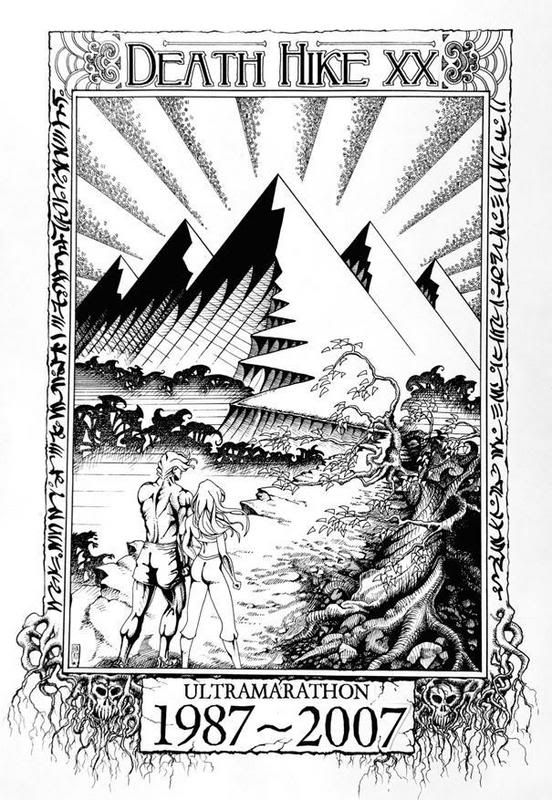
Excuse the rape and plunder, Vikings knew it unacceptable to die in your sleep. How can it be any better to live as such? Let me exit the earth with blood smeared on everything, sand in my lungs. Join me on the Death Hike and let's end the day with nothing but our consciousness piled on top of rock. Scrape away everything until we've finally found ourselves.

And why do we call our only chance at freedom our 'dream'? I'd rather call this job of mine the dream and those looming things my future. The time I will truly be awake.
»»  read more

Wednesday, May 02, 2007

"The Lonesome Crowded West"

Dreams about watching desert epics on television. Like the last thing I'd ever do is parachute into some Faustian existence out in the scrape and the dust and the blanched white bones. Not for immortality or atavism, mind you, merely for survival so I can drag my paralyzed legs back to the prison ship.

Sex=guilt. Ostensible participation in some hoax, or the tenderest of manipulations. I want; theirs is something different. The word itself a reptilian indictment, the act blatantly temporary. And yet hinting at the infinite.

You would martyr yourself for your cause if you really cared. Or perhaps we're just waiting for our opportunity in the fragments and foam rubber and medication.
»»  read more

Monday, April 30, 2007

Futureproof in MTZ

The weekend passed like the nauseous, glorious nights once did always. And Sunday morning I dragged myself up from the rheum and the ache, the gradual settlement of memories cast randomly out into the noise scant hours before. I am no solstice marking transition from dark scrawls on cave walls to constrained debate in the symposium's back-halls. I am alive in each instant. I die when the sun rises. Yuppified by some contrived crisis. Electrified each time I throw my dice in.

The ether of an evening pasted to walls dissolved in the instant you notice you're breathing. Or a glimpsed reflection hastens the ecstasy's bleeding. The spindly figure in the foreground pulls down the scaffolding and brickwork. The architecture of scant seconds plunging, inert.

Don't you recognize you belong to something different? Generation Edge looking over unconcerned. Why aren't you ecstatic in the collapse of the Empire of burden, not the energy required for orbit or Enlightenment but the toil demanded by this carefully planned haberdashery. Do you know how close to freedom you are?
»»  read more

Thursday, April 26, 2007

My grades this semester. Yes, I'm boasting


That one freakin' A. Damn!
»»  read more

Saturday, April 21, 2007

Yeoman of the Sewers

So .. . I just finished writing a short-story. Any critical opinion is greatly appreciated. It's below, or if its easier to read in Word or something else, hit me up and I'll e-mail it to you.


“What’s Trump?” the Captain’s demand almost sourceless between the echoing of the chamber and his great mound of white beard.
A collective hesitation as Bean meekly played his card; Gus finally and sarcastically:
“Spades.”
“No table talk!” Ulf, on Bean’s team and down several tricks to Gus and the Captain. His voice annoyed and mostly serious. The Captain played a mistake and Ulf victoriously slapped his laminate right Bauer to the table.

The four of them digest long hours in this fashion. Atrophying under bulky, drab suits to protect them from parasites, viruses and the infection on virtually every surface of the Sewer they collectively scrape and maintain. During downtime they sit in the enormous Combined Sewage Overflow because it is wide enough and tall enough to fool them. And the rectangular sun above casts enough light to bathe several city blocks of stained concrete in a natural glow.

Bean hated this job. Within recent memory he’d been a student of history at a crowded community college in the suburbs. He had hoped to find some order in the entropy he saw, to convince himself through anecdotes that things weren’t getting worse. But, it seemed, academia conspired against him. Funding interests and dwindling government aid incrementally snuffed his program out of existence and he soon found himself fighting the wolves in the form of creditors, and then landlords, and then others in the breadline. Eventually, this past spring, the Sewer Department threw him a bone. He would have tured jugular veins with a spear if he had to for that first paycheck.

The novelty of making money wore off almost instantly and through the first few months it was as if the job perpetually offended him. Recently, though, he tempered. The nauseating reek of humanity gradually receded. His skin sallowed, like Ulf’s, and when fully suited he could almost take a sudden immersion in waste without a grimace.

And this sort of test of grit was not uncommon. Just last month, Gus had to pull him out of a freak rush in one of the junctions during a swell. Tense safety lines and guttural screams down in the pipes. Facemasks fogged with exasperation. Finally Gus had hauled him up onto his feet, the bastard, and dislodged Bean’s leaky helmet. He laughed as Bean spat out some vile fluid that had leaked in; it was his contention that Bean would never really be a sewer man until he’d swallowed a mouthful of the stuff. “Topside people eat shit all day,” he was fond of saying, “we just have the balls to admit it.”

The Overflow was Bean’s favorite place in the Sewer. It was the only underground that didn’t excite claustrophobia. He liked the starkness of it, unencumbered by complexes of pipes or pumps. It was not a place to populate or regulate, but rather a space through which human matter and the city’s toxic run-off passed. Great mountains of water passing back out into the natural world, consuming its own poisons. The floor plan was only disrupted by strategic channels and a hand-railing and their table bolted to the concrete floor a few feet from the shaft of afternoon sun. At the far end of the room, there was a rough-hewn rectangle cut in the concrete. Big enough to pilot a Bobcat through. If someone were to now emerge from it, Bean thought, the sudden perspective would be jarring. He would appear tiny and alien, an anonymous figure out there on the underground horizon.

One game bled into the next. Victories merely breaks to smoke a cigarette in, or walk a few feet away and piss. Bean lost focus easily during these marathons. Going mute for long stretches except for a pre-packaged “pass” or “pick it up” and lolling his head back to look up at the distant ceiling. Gus re-told some awful joke, replacing one ethnicity for another, and shuffled. The awkward, stiff cards snapped out in a flourish; tiny machine gun fire. The arrangement of things way up on the ceiling, pipes and gears and catwalks and portholes still painted their urgent red and assembled in symmetry. They allowed Bean to suspend thought for the briefest of seconds before the Captain nudged the excess of his suit and he re-entered.

“Bean, pay attention, please. Ve don’t vant to lose another,” Ulf said in his dwindling Swiss accent. “ ‘s all strategy, you have to vatch vhat’s thrown.”
“Strategy?” Gus laughed. “It ain’t even strategy when you play this long. You just know.”
The Captain raised his eyebrow. A white cylinder, abruptly crooked at his confusion.
“You know. A Man just knows,” he continued. Swiped the trick from the table.
The blaring of the klaxons didn’t startle them. They would have been virtually unnoticeable had they all been helmeted. Ulf slammed his remaining three cards to the table; his hand was strong and he was livid. House rules said the game was over.
“Just, you know, just as a fellow is about to do something . . “
“Life happens,” the Captain said.
Gus assembled the cards and stowed them in his pouch. The players eased up out of their bolted chairs, and single-filed fifteen or twenty feet to a spot. Ulf wedged up a plate with a tool, and the Captain whistled down a ladder into the Overflow’s nerve center. The rest, Bean next, followed and Ulf again sealed the room behind them. As he stepped off the bottom rung, the small chamber vibrated. Then rumbled. And finally a jolting roar of water overhead.
The narrow hole fit three comfortably, and Bean was pushed right up to the Captain. He looked down at Bean, nearly a foot taller, and said something unintelligible.
“What?” Bean yelled. The roar of the water like the engorged howls of a prison fight above them.
“I said we are getting a lot of overflows for this time of the year,”
“Yes,” Bean said. Dimly cognizant that he might have noticed the same thing. Either way, of little import to him. “Yes we are.”
They would have as many as fifteen minutes down in the chamber with one another. The energy required for conversation keeping them awkward and blatant in their speech. Bean had embarrassed himself a number of times down there, having to shout ever louder “I just wish we could get some time off” and “I said, I don’t think there needs to be four of us.” He now just stayed quite, half-heartedly poised to respond to the Captain should he say something.
A myriad of pipes, confusing and tangled from three steps back, snaked around the room. Terminated at bulging junctions of painted steel, alien panels and gauges that Bean could not comprehend. He took a dim satisfaction the complication and order, the Sewer so vast he wondered if it was even aware of him. And yet it worked practically by itself. Of course, Ulf was constantly trudging down here; wiping the filth from his facemask and twiddling knobs heuristically. But the knobs really did the work; they told the stuff where to go, which pumps needed to be engaged, which drains needed to be uncovered.
“You think robots might be able to do take our jobs?” Bean asked, in the roar of water confusing the out-loud world with the thoughts in his head.
“What’s that, boy?” the Captain shouted back. Gus and Ulf were playing rock-paper-scissors in the white noise. Gus beating him mercilessly.
“I said, you think robots might be able to do our jobs” and the roar whined down as the last few words escaped. Bouncing off the metal pipes and eliciting shaking heads from the others. This merely meant that the largest slug of overflow had passed, there were still millions of gallons to go.
“Bean, my boy,” said the Captain, and wrapped a stained arm around him.
“Do you see these pipes?”
Bean and the Captain were squashed shoulder-to-shoulder, unable to turn fully in either direction. Sullen faces six inches from the melange.
“Yeah, I see them. Nevermind, I was just sort of . . uhm . . thinking out loud.”
“That’s the problem,” Gus said, “You think too much. What’s there to think about down here?”
“Bean,” the Captain continued, “this set-up you see before you, the controls, the pipes, the valves. It might not seem like much, but without them the City is nothing. A city swamped in its own filth cannot survive.”

“Of course, but we . . .” Bean attempted to interject. The water sloshing above them, the ocean stomach of the bloated city. “Tut tut . . without the action we take down here, the city is lost. I know it seems as though what we do is rather meaningless, tedious, and facetious,”
“Hey you sound like one of them preachers!” Gus said, pulling an apple from somewhere in the recesses of his suit.
“I sure do,” the Captain beamed “But, Bean, my point is. Something as important as that can’t be left up to computers. You young people think that technology is better than us. But I’ll tell you something . . computers can only do what we tell them to.”
“Besides,” Gus said, crunching through the snappy skin of his apple “You want to lose your job or something?”
Bean stared straight ahead.
“All I’m saying is, what I’m asking is . . do we need to be down here?”

“Of course we need to be down here. What do you think we’re doing all day?” The Captain retorted.

“And, Bean. If you hate it that much, no one down here’s got a gun to your head,” Gus said, thinly sarcastic as though he were literally holding said gun.
“You’re saying we’ve got a choice . . . ” and in the middle of mounting his tirade, a perfect sentence to finally dismiss Gus’s vulgarity with cold logic, Bean slipped on brown slime and braced his impact on the metal grating with his elbow. It was incredibly painful even through the suit.
Gus helped him back up with a rough jerk. The troop fell quiet and filed up the ladder. Bean imagined a tension, that he was now at odds with the group, but Gus and the Captain never seemed to commit an exchange to memory. He could never really speak to these people. Every attempt, whether conscious or not, to talk about anything other than cards, human waste or women was met with something between condescension to his age or a brief silence.
The procedures rolled along until the four of them finally sat back down at the table, the Captain squee-geeing it off with one arm of his suit and then flicking the stuff to the floor. He was the oldest and hardiest, and Bean imagined he’d been so desensitized that had Gus left his apple on the table, and had it miraculously survived the gush, Captain would have shook it dry and sunk his teeth in.

Bean, rubbing his elbow, felt some sort of utility and value. Though much of their time was wasted, every so often they moved as a unit to tackle some necessary problem. At these times he felt like a worker gnome, hapless maybe, but nevertheless pushing through the city’s bowel movement. Denigrating work, to be sure, but vital.
A new game started. The long-absent stench now returning unevenly to Bean’s nostrils. Sour at first and not obnoxious, what a businessman might smell if he wandered by the wrong grate in August. There would probably be nothing left to do until they punched out and the smaller night crew replaced them. Gus and the Captain lost two hands, and then the Captain’s look of dumb-founded consternation (as though his cards displayed hieroglyphs instead of hearts, clubs, spades, and diamonds) turned to urgency.

“Who cranked the hydros back on?” He thundered, standing up instinctively.

The unwritten code by which they operated required that Bean, the closest they had to a newb, double-back to correct mistakes in their collective memory. The urgency of potential backwash flattened any resistance, and only Bean’s uncharacteristic responsiveness kept the crew from hastily descending once again as a precaution. Unexpected action and a tiny surge in heart-rate. Perhaps it would be a close call and he would save the system with only seconds to spare.
Bean ran to the entrance, dimly envisioning the city far above him trembling in anticipation. An overwrought and complex beehive. An architecture of purposes relying on its weakest foundations. Relying now on Bean’s quick action.
He clanged down the stairs, the narrow tube and the space below completely odorless, and over to the valve they had neglected. As he moved to turn it, and alleviate enormous and building pressures, the wheel spun of its own accord. First dryly rubbing against his gloves but as he stepped back it gathered speed and made the two rotations under its own power.
Had no one hastily descended the ladder and rushed to open the valve, it would have made no difference. The captain, Gus, Ulf and especially Bean were suddenly not even drones.
He slowly returned to the game upstairs. To now truly waste time in a literal shithole with people he did not particularly like, so he could afford to eat in the scant, dark hours he got off. He dropped into his seat like a pile of antiques, letting gravity yank at his bones, and he thought, just for an instant, of saying something. He wanted to tell them so they could all give up the façade and go home and watch television or launch campaigns to win back ex-wives and girlfriends. Or maybe just go for a walk outside.
“Everything go alright down there?” the Captain asked.
But he couldn’t tell them. Either they had noticed similar goings-on and were afraid of the truth, or they would think him a pathetic liar. Or he could arrange it so they saw it for themselves; show them the grand futility laid bare like the contentious hand of a cheater.
The game resumed, and the smell returned in the way small folds of his suit would open and reassemble in the motions of snapping cards to the table.
The klaxons blared again, Ulf dropping both bauers and a trump king to the table in disgust. The siren wasn’t the same harrowing scream that signaled a complete flush but rather the meek holler of a clog somewhere under the city. One that hands would have to dislodge.
Ulf and Bean had to go, hardly any other option. Bean the newest, and his team losing at cards.
They walked away from the group, snapping buckles and tightening straps, paused at a cubbyhole to retrieve equipment and then trudged over to the stark rectangle in the wall.
The darkness in the tunnel mimics the deep, earthy black of cave diving. Stalactites of algae and filth. Their warm orange headlamps glistening over everything ahead. Bean and Ulf tied themselves together by a length of rope and sighed hunkered into a long uphill walk. The passage narrowed in stages as they climbed until they had to hunch over. A perpetual tiger trap of slick concrete. Some Pavlovian sense of duty the pressing wall at their back.
Bean was nearly dragged by the rope. A rhythm of tugs at each of Ulf’s forward steps. His legs trying to collapse or go limp at each one. The euphemism had failed, he remembered. It was over. He was not even a cog in the clockwork anymore. He was a mouth to feed, and twenty-four hours to occupy in the interest of preventing burglary or insurgency. Ulf looked back every few minutes in restrained irritation.
He, like Bean, had been given the job by some nseen bureaucratic hand after a dizzying stint of poverty and desperately waiting in lines. Swallowing dignity to beg some tender-hearted but eagle-eyed old marm for help. Support. The system, so efficient at automating and generating surplus, simply no longer needed them. Stupid day-workers like Bean, Gus, the Captain, and even Ulf could only stifle progress, could only gum up the works. As so it threw them a pittance and convinced them they were worthwhile.
“ulf!” Bean yelled.
“Vhat?” Not even fully turning.
“Hold on,”
Ulf took two or three more steps and stopped under the serrated light of a drainage. He turned and huffed, he worked too damn hard to put up with Bean sometimes.
“Listen,” Bean said to hold attention as he closed the gap. “I . . um .. I saw something down in the snakepit.”
“Really?” Ulf asked, “Vhat did the t’ermal expansion gauges say?”
“No, no. Listen. And you have to take me serious,“ where Gus and the Captain would have rolled their eyes Ulf merely looked away and then back.
“Ok. Vhat?”
“The valve that we turn, you know, the one that I turned after the flush earlier?”
“Of course,”
“Well, “ Bean said. “It moved on its own.”
“Vhat are you saying?”
“The valve turns itself, we don’t need to b e down here.” This last part under his breath as though he was suggesting it to Ulf subliminally.
Ulf looked at him with a frozen disbelief, not a reaction to Bean’s heresy, but simply unsure what to think. Barely able to articulate his confusion in Swiss, utterly incapable of doing it in English. Finally:
“I don’t beliefe you,”

A moment of passive reflection and consideration they’d be forced to call a “break” if asked and Ulf and Bean again trudged through the pipes to some nefarious trauma as far away as seemed reasonable. This time passed in silence. Ulf twice nearly turning back with some pithy insight or joking stab at the tangible doubt and biography that hung between them. Bean felt weightless and yet now bonded to the sewer by a force that acted not on appearance or heft, but on some less tangible quality. Really, some lack of quality that pulled him down through sluices of steel grating and dark shafts of concrete.
They arrived at the blockage. A stormwater reservoir that emptied out into a channel at their feet had coaxed an unprecedented mass of urban offal and the things that found solace in it to fully congeal and squeeze until the outlet was completely sealed. Bean poked at the blockage with an instrument. A blackish wad weighing hundreds of pounds.

The apparent task at hand was to skewer and slice the blockage until it conceded and fell into the channel in pieces. Here it could decompose naturally in the constant rinse of run-off. All tasks being menial, this one was of no particular notice. Save that Bean couldn’t resist the notion that if it were not for the teeming, squabbling population topside this problem would have never occurred. And yet, in the sewer’s new complexity, Bean saw no way for it to heal itself this time. He made a more determined, work-like stab at the mass.
“Vait, Bean. If you’re right, ‘zes vill fix itself. Just vait,”
And so they stood. The reservoir making incrementally angrier noises. The blockage making plastic squeaks as tons of water worked to force it through the eye of a needle. They waited, each sort of quietly daring the other to take no action as the wad pulsed and the chamber they stood in shook.
Finally the noise was replaced by a great rush of water somewhere on the other side. Some redundant and unfamiliar outlet eased the pressure on the blockage and the great squeezing mass relaxed. The sweep of water, as if blood circumventing arteries, tugged the mass away from the blockage and the channel surged.

Ulf was incredulous. Simply staring. And for Bean the smell finally pounced from the bushes. As fresh and repulsive as it was on his first day, but suddenly beyond merely nauseating. The fumes burned poisonous in his lungs. Bean’s eyes watered and crossed. His vision went blurry and after a graceless waving of arms to stay steady he careened into the channel loudly.

The current, stronger than it seemed and stronger as it deepened, yanked him beneath the filmy surface. One foot, Two feet. And then the safety line pulled taut. Warbled gibberish above the water. Bean reached a foot down, God how deep could it be, and launched himself weakly from the bottom.

His head surfaced briefly. Ulf pulling on the line, losing skittering steps to the current and Bean’s weight. A fresh shot of reek along with desperately needed air. He felt the burn of the sewer deep in his lungs and went limp. The back of his head smacking against some metal fixture, a brief unconsciousness as the indifferent Sewer pulled him back down under into the darkness and digestive system. Into the bowels, so much more profound in their strangeness. As alien to Bean as his own insides.
The line, the panicked umbilical cord between the terror and futility down in the pipes and the vindication and despair on the walkway, snapped. A jarring, hard sound somewhere in the penultimate static of water rushing over every inch of him. Swallowing him.
Bean was afraid. A hot ball of panic, starting in his gut and dispersing, splitting into smaller bursts of unbearable anxiety. The flashing images of grinding metal teeth and sharp edges testing the ferocity of the flow. He surfaced for fractions of a second in the few inches between the water and the pipe, his helmet filling with Sewer air and then back underneath to watch the invaluable little bubbles escape out into the blackness.

An unknowable quantity of time passed.

The flow of water calmed, not truly slower Bean knew, but without the turbulence, without the tiny accelerations beating away at his consciousness. He floated along, the nozzles of his helmet just above the water.

There was nothing in the pipe. Nothing he could do or any space to do it in. There was only to try and keep breathing and hope dimly that he ended up somewhere friendly to his soft, pink body. And yet even the safest fantasy of how it all might end failed to comfort him. If he could just sit down in the pipes forever, bobbing along and avoiding work.

As time went on, Bean started to convince himself that this would happen. He would drift here forever and acquiesce; learn to not care. Then there was a brief amplification in the rush and his numbing buoyancy blending almost imperceptibly, like a mother quietly exchanging a baby’s sleeping comfort in her arms for that of the bed, into pure weightlessness.
And light. Shocking and exhilarating light so that Bean’s enormous pupils could barely handle the unexpected luck and extraordinary freedom. And then plunged again into water; suddenly muffled and in slow motion. Bean was given to drift motionless for a moment as the bay scrubbed the sewer out of him. His eyes adjusted and, heavy in his suit, he looked up through the water at the purplish twilight. He had survived. And he was never going down into the Sewer again.
He pulled at his boots with an ineffective glove and just before he panicked they slipped off and he kicked himself upwards. His head broke the surface and his bleary periphery bulged with the city’s skyline. The city that thought him dead looming there in its sepia and soot, its chaotic afternoon bustle.
“It is a beehive,” Bean said, what felt like his very first words. And it didn’t really need him.
He swam toward it, no other choice really, and thought how tomorrow he’d wake up and go for a walk outside. Or visit the library. Or do absolutely nothing at all.
»»  read more

Friday, April 20, 2007

On Binary Opposition

Sorry if this doesn't make sense, threw it up rather quickly

we have structured life on binary oppositions. Good versus evil, right versus wrong, love versus fear, rich versus poor. However, binary opposition is inadequate to resolve the existential turmoil that is at the basis of all dissatisfaction and epiphany. It is only when the universe is exposed as the multifarious and overlapping co-existence of concepts that one truly approaches the Genuine Experience. Being geared toward binary thinking, it is only when binary opposition fails to define a characteristic of our experience that we are pushed closest to truly living.

Marshall McLuhan states that whenever a system (be it an organizational system such as the Internet, an aesthetic system such as Impressionism, a philosophical system such as Existentialism and so on) is pushed to the limits of its capability, there is a sort of reversion to a system that is simpler (structurally) but more comprehensive and capable of handling more information. For example, think of spoken language. The way one learns is to identify “things”. One learns nouns for objects and verbs for overt actions. These words themselves are made up of tiny bits of information (syllables and letters). Eventually (and rather quickly), simply being able to identify “things” is no longer adequate. One needs to be able to express relationships between “things” as well as incorporate abstract thought into very non-abstract situations. The language system goes through a reversion. It becomes simpler in that words lose some of the “concreteness” in their meaning, the upshot being that whole words now represent the basic unit of language rather than syllables or letters. One may argue that poetry is an attempt to take that further and use whole lines as the basic unit of information (and potent information, with multiple connotations).

We experience our lives using systems that are inadequate to explain the universe and ourselves within it. This is not an indictment; we are geared for a relatively simple life on a tiny planet. Cultural evolution (including the idle time available to agricultural societies, the broad sharing of information from society to society, and the ingenuity that allowed a frail, pink bipedal to dominate the earth) has repeatedly pushed us up against the very limits of our systemic capability to understand. For instance, creation myths served to satisfy our questioning nature for a time but eventually it grew inadequate. We were (or still are) forced to accept some new informational system to explain our life experience. The same occurs in the arts. We see a steady evolution in how art is produced, understood, how it interacts with our life, etc. This is because art is a powerfully self-propelling memetic system. I read great literature, learn from it, and understand that while it may be brilliant it fails in some way to render MY experience fully. Thus I am forced to make attempts, using the informational/philosophical/aesthetic systems I’ve encountered as a sort of cipher to decode the emotional communion I’ve made with the world.


Where does binary opposition come into play?
Binary opposition is the principal taxonomic activity We undertake. The first test we put any new “thing” to (a piece of art, a concept, a new food) is into the “good” and “bad” categories. Though I have little scientific support (but also no contradictory science), I would argue that this divvying up of our experience is directly related to our evolution. When our decisions were primarily concerned with life and death, it was of prime importance to efficiently divide the world up into things that were dangerous and things that were good. As time went on and our brains got bigger, we started to introduce what seems like ambivalencies. Fire is dangerous, but extremely useful. Water is essential to life, but can be deadly in the winter or can drown us. Upon closer examination, this is still binary division. Dangerous things are divided up into those that can be useful (“careful” things like fire) and things that are not (rotten meat). Moving from the simple classifications to these more nuanced classifications represented a shift. Our systems of understanding began to be inadequate, and thus “things” had to be considered not as monolithic entities, but as collections of characteristics (some bad, some good). This was a giant step forward in cultural evolution.

However, that understanding of our experience is only partial. First, it has been derived strictly by our subjective experience as humans with very particular needs (and thus is not required to be universally true). Secondly, we’ve merely divided the world into millions of pieces rather than a few and each “piece” still represents one side of a binary opposition. If you are familiar with calculus, you will know that one of the most important early uses for it was its ability to accurately measure the area under a curve. Calculus can take any function, no matter how wily and extreme its curves, and precisely derive the area underneath it. Prior to calculus, the only method to do this (and important scientists such as Johannes Kepler did this for integral astronomy calculations) was to divide the area under the curve into as many little squares as possible, and add up their areas. This is not only tedious and energy-intensive, its inaccurate. Our informational system, mathematics, was inadequate and thus we were forced from a system of binary oppositions (the question of accuracy presumes a binary friction: there are spaces under the curve that aren’t covered by squares) to one that could explain things more comprehensively and simply.

My point is this: we have made attempts to explain life by adding up a million tiny squares. It has been relatively adequate over the centuries, but as the spread and growth of information increases exponentially there are far too many nooks and crannies for us to stick our squares in. Our existential grief, this sense that something is missing and that the true meaning of our experience is fleeting and intangible, is our hackles being raised at the inaccuracy inherent in summing up a million tiny squares in our lives. We require nothing short of a calculus of life; a system of pattern recognition (and McLuhan says that only the artist is truly capable of this) and an identification of a new, simpler and yet more comprehensive system of understanding ourselves.
»»  read more